
A 165-page collection of scientific, medical, agricultural and cultural writing on poi and kalo, gathered by the Poi Company and scanned in 2008. This is a guide to what is inside it, and where to find it.
Download the complete collection →
Please cite the original papers rather than this page — each entry below carries its full journal reference.
What this is
Over half a century, anyone who wanted to know something serious about poi ended up writing it down in an obscure place: a university experiment-station bulletin, a dietetic journal, a typed memorandum circulated to fifteen people. Those papers were never collected anywhere. This packet is the collection — assembled a piece at a time, then photocopied, then scanned.
Read end to end, it tells one long story. Hawaiians lived on poi and had famously good teeth and physique. Science spent forty years working out why: it is alkaline where nearly every other starch is acid, its calcium and phosphorus are unusually well absorbed, it is gluten-free, and it is so nearly non-allergenic that it was fed to babies who could tolerate nothing else. Meanwhile the economics ran the other way. Every attempt to sell poi to the mainland failed, the acreage shrank, the farmers aged, and the price climbed until poi became a luxury in the place it had once fed everybody.
The documents are listed below in the order they appear in the PDF. Every scanned page carries a stamped page number in its bottom corner, so the ranges given here match what you will see on screen.
Find it by subject
Medicine & nutrition
- Poi and the medical profession 3–46
- Allergy prevention in infants 47–53
- Thiamine, riboflavin, niacin 105–108
- Glaser’s Rochester report 109–112
- Poi and intestinal disease 124–127
Botany & varieties
- Taro as a food 70–74
- Taro varieties in Hawaii 75–91
- Some facts about taro 63–69
Markets & economics
- The mainland market 92–101
- Mills, prices, 1943–1991 54–57
- Taro Industry Analysis No. 4 128–165
- Economic Fact Sheet #1 150–153
Culture & history
- Kalo and ‘uala 114–123
- Poi has potentialities 58
- The girl in Akron 59–62
- Poi is the staff of life 113
If you read only four pages, read these
In the late 1960s the Summit County Welfare Department in Akron, Ohio began air-freighting poi from Hawaii for a three-year-old girl with cerebral palsy who weighed twenty-three pounds and was allergic to every other food. She was fed through a gastric tube. Canned poi had worked; her doctors then needed it powdered. A social worker named Sally Crisp found a Hawaiian firm willing to ship fifteen pounds of freeze-dried poi — about three months’ supply — at $1.25 a pound, and the assistant welfare director authorised the air freight himself.
“It’s a life-or-death situation,” Crisp told the reporter. Three pages later in this packet is the reply she received from Honolulu: a plain, kind letter from Mrs Claire Ho, a public-health nutritionist, enclosing three photocopied articles for her pediatricians and explaining why poi had become so expensive — land values were high, the farmers were few, and the ones retiring were not being replaced by younger men.
Pages 59–62 · Akron Beacon Journal clipping and Department of Health correspondence
The collection, page by page
Cover sheet
State of Hawaii, Department of Health · Honolulu
Departmental letterhead from the Cayetano administration, filed under “HPED / Nutr”, which served as the cover for the packet when it was circulated.
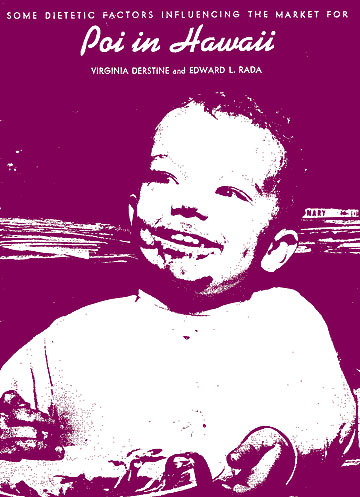
Some Dietetic Factors Influencing the Market for Poi in Hawaii
Virginia Derstine, Special Economic Assistant, and Edward L. Rada, Market Economist · Agricultural Economics Bulletin 3 · University of Hawaii, College of Agriculture · July 1952 · commonly cited as Poi in Hawaii
The centrepiece of the collection, and the most thorough thing ever written about how doctors actually used poi. In the spring of 1951 the authors surveyed 351 practising physicians across the Territory, then sixteen general hospitals holding 2,524 patients. A clear majority recommended poi both as a staple for healthy infants and therapeutically — for convalescent and soft diets, malnutrition, cereal allergy, elderly patients with no teeth, and gastric ulcers. Most advised starting babies at three months. The findings are reproduced in full: the questionnaire, forty pages of tabulated responses, and — the best reading in the packet — the doctors’ verbatim comments, which are frank, opinionated and occasionally very funny. Nearly half thought the mills should be more sanitary.
Use of Poi in the Prevention of Allergic Disease in Potentially Allergic Infants
Alexander Roth MD, Robert M. Worth PhD, Ira J. Lichton PhD · Annals of Allergy, Vol. 25 · September 1967
A controlled trial run out of Kaiser Foundation Hospital and the University of Hawaii, following 132 Honolulu infants from allergic families through their first four months on hypoallergenic diets. Seven per cent developed definite allergic symptoms. Infants fed poi and infants fed rice cereal carried a similar risk, and poi was well tolerated throughout. The authors’ conclusion is deliberately modest — poi “may be considered” for the potentially allergic infant, particularly where there is a family history of cereal allergy — but it is the only properly designed clinical study in the collection.
Cultivation, Mills and the Price of Poi charts
Statewide survey material · 1991
Four pages of graphics. An island-by-island map locating every working poi mill in 1991 — Waimea, Kapa‘a, Waiahole, Kalihi, Aloha, Honolulu, Moloka‘i, Kona ‘Ohana — with wetland and dryland cultivation marked separately. Then farm-gate taro prices for 1990, and a nominal-versus-real price series running from 1943 to 1991. The last page, “The Realities in the Price of Poi”, is a single blunt table setting the cost of production against everything else in the Wai‘anae diet, and answers the question of why poi is expensive without sentiment: labour has better-paid alternatives, land costs money, fertiliser tracks the price of oil, and the fish that once came free does not.
Poi Has Potentialities
Clarence L. Hodge · report of the First State Taro Conference, Honolulu
A report from the conference that brought roughly 150 people together — pediatricians, nutritionists, government officials, and executives from Castle & Cooke, Ralston Purina, Foremost Dairies and Love’s Bakery — to ask three questions: what the medical research actually showed, whether a national market existed, and whether Hawaii could grow enough taro to serve one. Dr Jerome Glaser of Rochester gave the keynote.
The Girl in Akron
Hawaii Economic Review, Summer 1965, Department of Planning and Economic Development · Akron Beacon Journal clipping · letter from Mrs Claire Ho, Nutrition Branch, to Miss Sally Crisp, Summit County Welfare Department
Four loosely ordered pages from the packet: two of state economic and public-welfare statistics, one newspaper clipping, and one letter. Together they carry the human story described above — a child in Ohio kept alive on freeze-dried poi shipped four thousand miles, and the Honolulu nutritionist who quietly helped arrange it.
The correspondence refers to the Roth paper, which places the letter in 1967 or later, though it sits beside 1965 material in the scan.
Some Facts About Taro
Unsigned briefing paper
A compact primer, and the best short introduction in the packet for a general reader. Taro is among the oldest cultivated crops on earth: Chinese books mention it by 100 BC and it was grown in Egypt before Pliny. The section on cultivation describes how far the old Hawaiians took it — paddies from twenty square feet to a third of an acre, irrigation systems intricate enough to dry any single paddy for fallowing, and varieties and planting times chosen so that harvest could be continuous year-round. It closes with nutritive retention tables and references.
Taro (Colocasia esculenta) as a Food
Martha Potgieter, Hawaii Agricultural Experiment Station · Journal of the American Dietetic Association, Vol. 16, No. 6 · June–July 1940 · pp. 537–540
The oldest paper in the collection. Potgieter sets out composition, iron and iodine content, and the excess alkalinity of taro ash, and explains the acridity that makes raw taro inedible — microscopic needles of calcium oxalate, destroyed by thorough cooking. She notes that of more than eighty distinct forms studied at the station, sixty-nine were native to Hawaii, and that an acre of taro yields five to ten per cent more calories a year than an acre of rice. Her account of the estimated 300,000 Hawaiians living at contact on poi, sweet potato, fish and limu, with no milk but human milk, is the origin of the good-teeth argument that recurs throughout the rest of the packet.
Taro Varieties in Hawaii
Bulletin 84 · Hawaii Agricultural Experiment Station
A full taxonomic treatment, and the longest single document here. Each variety gets a botanical description — petiole length and colour, leaf blade dimensions, the shape of the sinus, the colour of the piko, corm flesh, maturation time, and where on which island it was planted. The Japanese varieties are distinguished from the Polynesian ones and noted as unsuitable for poi. Ends with finding lists that let you identify a plant from its characteristics, a glossary of Hawaiian descriptive terms, and plates.
Of interest to anyone growing kalo today: many of these varieties are now rare or lost, and the descriptions here are the reference record.
Mainland Market for Taro Products: A Preliminary Study
Edward L. Rada, Market Economist · Agricultural Economics Report No. 13 · University of Hawaii, College of Agriculture · December 1952
The commercial companion to Bulletin 3, and the most quietly devastating document in the collection. Rada’s export history is a catalogue of good ideas that did not work: taro flour manufactured in Hawaii as early as 1874; King Kalakaua signing a subsidy for its manufacture and export in 1886; Taroena and Taro Mana; Hawaiian Taro Products Ltd in the 1930s with Taro-Lactin and Taroco, which could not be made to pay; the Galen Company of Berkeley, which spent three years and $25,000 promoting Pay-o-Meal and Pay-o-Lin to American physicians before the war cut off its supply, and which was still receiving enquiries from doctors more than a decade later. Rada’s verdict on poi as a mainland staple is flat — rice and potatoes hold the ground, most adults dislike the texture, and on the Pacific Coast poi had an unsavoury reputation extending well beyond people who had actually tried it. He locates the real opportunity in dietary foods: allergy, gastrointestinal disorders and low-sodium diets for hypertension, a market he thought potentially as large as the entire baby-food business. His condition for getting there is the one thing that never happened — clinical research conducted on the mainland and published in the medical journals.
Update on Taro Happenings memo
Jim Hollyer, The Taro Project, via Dr Ken Rohrbach · University of Hawaii at Manoa, CTAHR · 10 May 1990
A circular to all UH taro researchers, attaching the current list of funded taro research and announcing that the taro bibliographic database had gone online with some 3,400 citations and abstracts. The attached table lists every principal investigator and project running as of 3 May 1990, with planned dates — a useful snapshot of who was working on what.
Taro as a Source of Thiamine, Riboflavin, and Niacin
Carey D. Miller, Adelia Rauer and Helen Denning, Foods and Nutrition Department, Hawaii Agricultural Experiment Station · Journal of the American Dietetic Association, Vol. 28, No. 5 · May 1952 · pp. 436–438
A careful study of what cooking costs. The authors measured the three B vitamins in raw and cooked taro corms and leaves, prepared both in the laboratory and by three commercial poi factories, then measured the paiai again after three days of souring at room temperature. Thiamine retention ranged from 59 to 89 per cent depending on variety, and souring had little further effect. An honest paper: where the numbers between two factories did not behave as expected, they say so and decline to explain it.
Poi: Its Use as a Food for Normal, Allergic and Potentially Allergic Infants
Jerome Glaser MD, Ruth A. Lawrence MD, Anne Harrison MD and M. Richard Ball MD · University of Rochester School of Medicine and Dentistry · abstract of a report dated 25 January 1965
The most quotable summary of the medical case. Glaser’s group found poi as adequate as ordinary cereals for infant feeding and well tolerated even by premature infants, and argued it should be the first carbohydrate given to babies born into allergic families — noting that allergic disease accounted for almost a third of chronic illness in American children under seventeen, and that asthma alone caused nearly a quarter of chronic-illness school absence. He sets out poi’s peculiar advantages: alkaline rather than acid, which he credits for the teeth of the ancient Hawaiians, and free of gluten, which made it worth investigating for coeliac disease and cystic fibrosis. His recommendations are practical and were largely ignored — standardise the composition batch to batch, add iron, keep working on dehydration to cut shipping bulk, and develop poi blended with fruit and vegetables the way cereals were.
Fare of the Country: In Hawaii, Poi Is the Staff of Life clipping
Newspaper travel feature
A visitor’s-eye piece describing poi taken alternately with laulau, kalua pig, lomilomi salmon and pipikaula, and quoting $28 for the Sunday Hawaiian menu at the Royal Hawaiian with island songs and dances. A period curiosity, and a reminder of how differently poi was presented to tourists and to patients.
The Staple Crops, Kalo and ‘Uala
Chapter 4 of La‘au Hawai‘i: Traditional Hawaiian Uses of Plants · with related pages on Makahiki and the worship of Lono
The cultural counterweight to all the chemistry. Kalo and ‘uala were not merely the carbohydrate base of the Hawaiian diet but kinolau — bodily forms — of the gods Kane and Lono. Dr Handy’s interviews in the 1930s gathered 342 names for kalo varieties and 230 for ‘uala, which the chapter offers as one measure of their cultural weight. It traces taro’s domestication to the New Guinea highlands five to ten thousand years ago, follows the two genetic lines out of mainland Asia through the Ryukyus, and explains how the traditions of Lono strengthened as population pressure pushed settlement into drier land better suited to sweet potato. The surrounding pages describe the Makahiki — the akua loa carried in procession to each ahupua‘a, and the closing ceremony at Kealakekua Bay where Lono’s canoe was provisioned and set adrift.
The running heads identify the book; the author, Isabella Aiona Abbott, is not named on the scanned pages.
The Possible Role of Poi in the Epidemiology of Infectious Intestinal Diseases
George Fung and O. A. Bushnell PhD, Department of Bacteriology, University of Hawaii · Hawaii Medical Journal, Vol. 7 · March–April 1948 · pp. 296–299
The one paper that complicates the story, and the most interesting for it. Fung and Bushnell deliberately contaminated poi with intestinal pathogens to test the self-purifying reputation of fermentation. It holds — but only at room temperature, and only with time. Their conclusion is a genuine paradox: poi stored carefully in a refrigerator is the more dangerous, because pathogens can persist in it for as long as eight days, while poi left out purifies itself within three. As they put it, under ordinary conditions in the home, the more sour the poi is, and the sooner it gets sour, the safer it is to eat.
Taro Industry Analysis No. 4 — Worksheets
Circulated by Jim Hollyer, Taro Project · UH Manoa, CTAHR, Department of Agricultural and Resource Economics · covering memo 6 June 1990
The industry’s own problem list, worked through topic by topic: land, water, labour, insect control, disease control, weeds, machinery, transport and marketing. Each section states the analysis, names the bottleneck, assesses the impact of leaving it unresolved, and assigns the action to a responsible agency. Dry in tone and unsparing in content — root aphids on the Big Island, corm rots with no established etiology, no herbicide registered for taro, no mechanical harvester, and a tractor problem nobody had solved.
Taro Industry Analysis No. 4 — Part I: The State of the Industry
UH Manoa, CTAHR · 1990
The narrative half, and the clearest statement anywhere in the packet of how the industry actually worked. It identifies four distinct taro markets in Hawaii — dasheen, poi, Chinese and Samoan — each with its own clientele, its own varieties and its own seasonal demand. It counts about twelve corm-to-poi processing facilities statewide. The numbers record a transition: total production down from 6.2 to 6.0 million pounds between 1988 and 1989 while farm-gate value rose to $1,996,000 on higher prices; wetland acreage falling every year and dryland acreage rising; Kaua‘i still 64 per cent of state production; poi taro acreage down seven per cent while Chinese taro rose twenty-one per cent; and taro grown for chips nearly doubling in a single year.
Taro — Economic Fact Sheet #1
Kevin M. Yokoyama, James R. Hollyer, Stuart T. Nakamoto and Kulavit Wanitprapha · Department of Agricultural and Resource Economics, CTAHR, University of Hawaii · June 1989
Taro placed in world context. It is the fourteenth most consumed vegetable on earth: 12.6 billion pounds grown worldwide in 1987, of which Africa produced eight billion and Oceania 667 million, against Hawaii’s 430 acres. The United States imported 47.4 million pounds of fresh, chilled or frozen taro in 1986, almost 42 million of it from the Dominican Republic alone. The sheet also sorts out the taxonomy that confuses everyone — Colocasia against Xanthosoma, and why “dasheen” and “eddoe” mean opposite things in the Caribbean and the Pacific — and lists the processing options, from flour at a 21 to 25 per cent conversion yield to chips, silage, cosmetics and ice-cream flavouring.
Taro Industry Analysis No. 4 — Summary Tables tables
UH Manoa, CTAHR · 1990
Twelve pages of landscape summary tables condensing the worksheets into ranked bottlenecks by subject — land, water, diseases, pest control, weed control, fertilisation, machinery, post-harvest handling and marketing — each with its priority, the possibility of resolving it, and the resources it would take.
About the scan
The papers were photocopied over many years before being scanned in 2008, and the reproduction varies accordingly — some pages are crisp, others are third-generation copies with handwriting in the margins. Every page carries a stamped provenance line and page number in the bottom corner.
The scan includes a searchable text layer, so the whole 165 pages can be searched in any PDF reader. Be a little sceptical of it on the older pages: the optical character recognition struggles with the 1940 and 1948 typefaces, and searching for an unusual word may find nothing even when the word is plainly there on the page.